

New map shows that only 13% of the oceans are still truly wild
- Written by: Kendall Jones, PhD candidate, Geography, Planning and Environmental Management, The University of Queensland
Just 13% of the world’s oceans are now free from intense human activities such as fishing, according to a new map of ocean wilderness areas.
Our research, published in the journal Current Biology, shows that only 55 million square km of the global ocean can still be classified as “wilderness”, out of a total of 500 million square km.
There is almost no wilderness left in coastal seas, where human activities are most intense. Much of the remaining marine wilderness is clustered around the poles or near remote Pacific island nations with low populations.
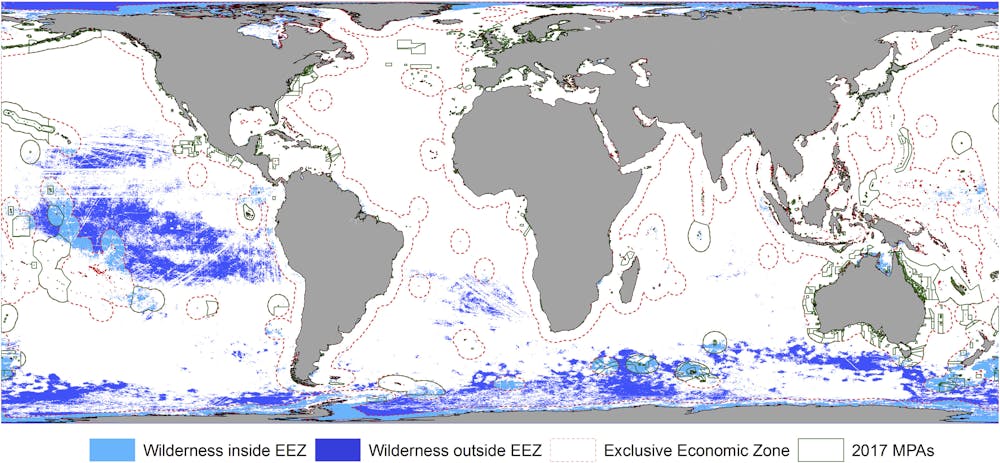 Marine wilderness in exclusive economic zones (light blue), in areas outside national jurisdiction (dark blue), and marine protected areas (green).
Jones et al. Current Biology 2018
Marine wilderness in exclusive economic zones (light blue), in areas outside national jurisdiction (dark blue), and marine protected areas (green).
Jones et al. Current Biology 2018
Humans rely on the ocean for food, livelihoods, and almost three-quarters of atmospheric oxygen. We use the ocean for the vast majority of global trade, and more than 2.8 billion people rely on seafood as an important protein source. It’s little wonder that more than eight in ten Australians live within 50km of the coast.
Earth’s ocean wilderness areas are home to unparalleled levels of marine life and are some of the only places where large predators are still found in historical numbers. Top predators such as sharks and tuna depend on these areas, as their slow reproduction rates make them particularly susceptible to decline even at mild levels of fishing.
Even the strictest, best-managed marine reserves cannot sustain the same levels of wildlife diversity as wilderness areas. This is either because reserves are too small, or because human activities in neighbouring areas impact wildlife as soon as they swim outside of reserve boundaries. According to our research, only 4.9% of marine wilderness is currently within marine protected areas.
There is evidence that wilderness areas are more resilient to rising sea temperatures and coral bleaching – stressors that cannot be halted without globally coordinated efforts to reduce emissions. These areas also give scientists a true baseline for system health, providing important information for restoring degraded marine ecosystems.
Threats to wilderness
Human impacts on marine ecosystems are becoming more intense and widespread each year, threatening wilderness areas across the planet. Fishing is now one of the most widespread activities by which humans harvest natural resources. Industrial fishing covers 55% of the ocean, an area four times larger than is used for terrestrial agriculture. In many places, fishing has become so intense that large predators and charismatic species such as sea turtles have almost been wiped out.
Technological improvements have allowed humans to fish in the farthest reaches of international waters. In the high Arctic, places that were once safe because of year-round ice cover are now open to fishing and shipping as warming seas melt the ice.
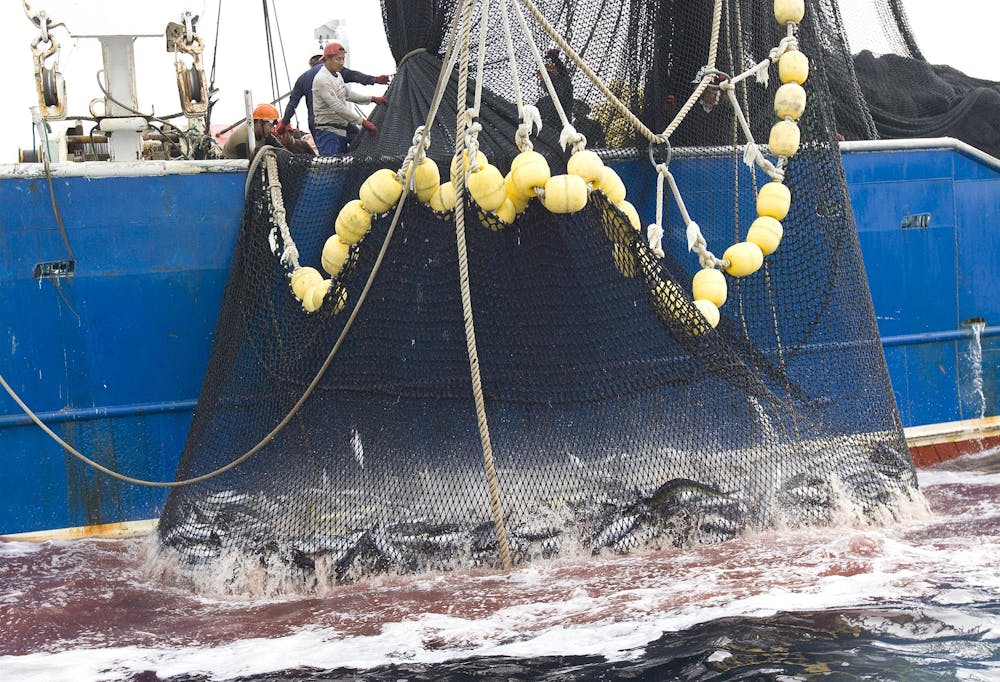 Intensive fishing now covers more than half of the global ocean.
Greenpeace/AAP Image
Intensive fishing now covers more than half of the global ocean.
Greenpeace/AAP Image
Even in nations with world-class fisheries management, such as Australia and the United States, marine environments are being severely impacted by sediment and nutrient runoff due to poor land management and deforestation. Sediment runoff onto the once pristine Great Barrier Reef is now five to ten times higher than historical levels, contributing to declining coral diversity and more frequent crown-of-thorns starfish outbreaks, and reducing the resilience of reefs against climate change.
Can we save the last of the wild?
Marine wilderness is overlooked in both global and national conservation strategies, as these areas are often assumed to be free from threatening processes and are therefore not a priority for conservation efforts. Our results show that this is a myth – wilderness areas in the ocean and on land are being rapidly lost, and protecting what remains is crucial. The Arctic, once thought of as untouched, is now likely to see new shipping channels, fisheries, and mining operations as sea ice disappears.
Protecting wilderness will require a combination of national and international efforts, but the fundamental goal must be to curb the impacts of current threats such as commercial fishing, shipping, resource extraction, and land-based runoff.
In nations like Australia and Canada, which still have substantial wilderness remaining within their national waters, using marine protected areas or fishery management regulations to protect wilderness will be crucial. Because even low levels of human activity can severely impact vulnerable species such as sharks and tuna, these areas should be strictly protected and cannot allow activities like commercial fishing.
However, current government plans to almost halve the area of strict protection in the Australian marine reserve system do not bode well for the future of wilderness protection.
Read more: Australia’s new marine parks plan is a case of the Emperor's new clothes
While protecting wilderness within national waters is legally straightforward, preserving wilderness on the high seas will likely prove much more challenging, as no country has jurisdiction over these areas. One option may be to harness existing international and regional agreements, such as Regional Fisheries Management Organisations – international agencies formed by countries to manage shared fishing interests in a certain area. These organisations are already accustomed to set fishing limits, and have been used to close large areas of the high seas to damaging bottom-trawl fishing. An extension of their powers to create high seas conservation areas is certainly feasible, but this is likely to require substantial lobbying from member nations.
Read more: New laws for the high seas: four key issues the UN talks need to tackle
The need for improved high-seas management is also now being recognised by the international community, with the UN currently negotiating a “Paris Agreement for the Ocean” – a legally binding high-seas conservation treaty to be established under the existing Law of the Sea Convention. Australia, as a wealthy nation and a signatory to fishing agreements in the Pacific, Indian and Southern Oceans, has the potential to be a world leader in marine wilderness conservation if it so chooses.
Just like wilderness on land, pristine oceans are difficult to restore once lost. Our research should be a clarion call for immediate action to protect the world’s remaining wild oceans so that future generations can see the sea as it once was.
Authors: Kendall Jones, PhD candidate, Geography, Planning and Environmental Management, The University of Queensland
Read more http://theconversation.com/new-map-shows-that-only-13-of-the-oceans-are-still-truly-wild-100820


 Daily Bulletin


