

Read The Times Australia

Daily Bulletin

Businesses think they're on top of carbon risk, but tourism destinations have barely a clue

  • Written by: Susanne Becken, Professor of Sustainable Tourism and Director, Griffith Institute for Tourism, Griffith University

The directors of most Australian companies are well aware of the impact of carbon emissions, not only on the environment but also on their own firms as emissions-intensive industries get lumbered with taxes and regulations designed to change their behaviour.

Many are getting out of emissions-intensive activities ahead of time.

But, with honourable exceptions, Australia’s tourism industry (and the Australian authorities that support it) is rolling on as if it’s business as usual.

This could be because tourism isn’t a single industry – it is a composite, made up of many industries that together create an experience, none of which take responsibility for the whole thing.

But tourism is a huge contributor to emissions, accounting for 8% of emissions worldwide and climbing as tourism grows faster than the economies it contributes to.

Read more: The carbon footprint of tourism revealed (it's bigger than we thought)

Tourism operators are aiming for even faster growth, most of them apparently oblivious to clear evidence about what their industry is doing and the risks it is buying more heavily into.

If Australian tourist destinations were companies they would be likely to discuss the risks to their operating models from higher taxes, higher oil prices, extra regulation, and changes in consumer preferences.

Aviation is one of the biggest tourism-related emitters, with the regions that depend on air travel heavily exposed.

But at present the destination-specific carbon footprints from aviation are not recorded, making it difficult for destinations to assess the risks.

A recent paper published in Tourism Management has attempted to fill the gap, publishing nine indicators for every airport in the world.

The biggest emitter in terms of departing passengers is Los Angeles International Airport, producing 765 kilo-tonnes of CO₂ in just one month; January 2017.

When taking into account passenger volumes, one of the airports with the highest emissions per traveller is Buenos Aires. The average person departing that airport emits 391 kilograms of CO₂ and travels a distance of 5,651 km.

The analysis used Brisbane as one of four case studies.
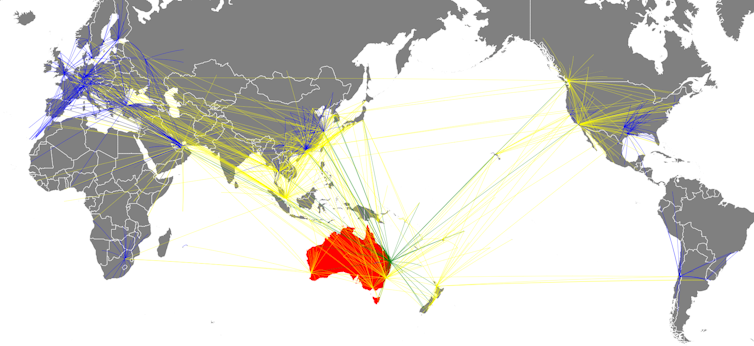
Businesses think they're on top of carbon risk, but tourism destinations have barely a clue Most of the journeys to Brisbane are long.

Brisbane’s share of itineraries under 400 km is very low at 0.7% (compared with destinations such as Copenhagen which has 9.1%). That indicates a relatively low potential to survive carbon risk by pivoting to public transport or electric planes, as Norway is planning to.

The average distance travelled from Brisbane is 2,852 km, a span exceeded by Auckland (4,561 km) but few other places.

As it happens, Brisbane Airport is working hard to minimise its on-the-ground environmental impact, but that’s not where its greatest threats come from.

Read more: Airline emissions and the case for a carbon tax on flight tickets

The indicators suggest that the destinations at most risk are islands, and those “off the beaten track” – the kind of destinations that tourism operators are increasingly keen to develop.

Queensland’s Outback Tourism Infrastructure Fund was established to do exactly that. It would be well advised to shift its focus to products that will survive even under scenarios of extreme decarbonisation.

They could include low-carbon transport systems and infrastructure, and a switch to domestic rather than international tourists.

Experience-based travel, slow travel and staycations are likely to become the future of tourism as holidaymakers continue to enjoy the things that tourism has always delivered, but without travelling as much and without burning as much carbon to do it.

An industry concerned about its future would start transforming now.

Read more: Sustainable shopping: is it possible to fly sustainably?

Authors: Susanne Becken, Professor of Sustainable Tourism and Director, Griffith Institute for Tourism, Griffith University

Read more http://theconversation.com/businesses-think-theyre-on-top-of-carbon-risk-but-tourism-destinations-have-barely-a-clue-105375

Business News

Is Your Brand Showing Up in AI Search? Most Melbourne Brands Aren't.

The New Front Door Nobody Told You About Something changed. Quietly. Without a press release. The way buyers find businesses in Australia has been rewired. Not replaced, rewired. Google isn't dead...

Daily Bulletin - avatar Daily Bulletin

How Australian Businesses Can Measure SEO ROI

SEO can feel vague when you are staring at a dashboard full of numbers that do not clearly connect to revenue. The key is to measure the right signals in the right order, then tie them back to outcome...

Daily Bulletin - avatar Daily Bulletin

How Commercial Roller Shutters Improve Site Security Without Slowing Operations

Security upgrades can be frustrating when they make everyday work harder. A door that takes too long to open, creates bottlenecks at shift change, or fails at the worst time can turn “better protectio...

Daily Bulletin - avatar Daily Bulletin

Why a Document Destruction Service Still Matters for Modern Businesses

Businesses generate large volumes of information every day, from staff records and contracts to invoices, reports and customer files. While attention often focuses on how documents are stored, the way...

Daily Bulletin - avatar Daily Bulletin

Bicycle Rack Safety and Space-Smart Storage

Bike storage problems usually show up as small annoyances first: tangled handlebars, scratched frames, and bikes that topple when you pull one out. Over time, those issues become safety risks, especia...

Daily Bulletin - avatar Daily Bulletin

How to Tell if a Childcare Centre Is a Good Fit for Your Child

Choosing childcare can feel like you’re making a huge decision with limited information. Tours are short, centres are often on their best behaviour, and your child might act differently in a new space...

Daily Bulletin - avatar Daily Bulletin

Car Import Timeline: What Usually Happens at Each Stage

Importing a car into Australia can feel confusing because multiple agencies and checkpoints are involved, and the timeline is shaped as much by paperwork quality as it is by shipping speed. The most u...

Daily Bulletin - avatar Daily Bulletin

Portable Toilet Hygiene Standards Explained: Clean vs Sanitised vs Disinfected

In portable toilet servicing, the words clean, sanitised, and disinfected often get used as if they mean the same thing. They don’t. And that difference matters because a unit can look tidy and still ...

Daily Bulletin - avatar Daily Bulletin

Options Available When a Company Faces Financial Distress

Financial distress can develop gradually or arrive suddenly, and when it does, the decisions made in the early stages often determine what options remain available later. Directors who act promptly ...

Daily Bulletin - avatar Daily Bulletin

The Daily Magazine

What Actually Makes a Good Criminal Lawyer in Melbourne

Most people only think about this question once. That is usually too late. Most people charged wi...

Why Working With A Chatswood Tutor Can Improve Academic Performance

Academic expectations continue increasing for students across primary school, high school, and senio...

Is It Worth Getting Solar Panels in Melbourne?

The real question is not whether solar works in Melbourne. It works. The question is what it is co...

How A Diploma Of Project Management Builds Practical Skills For Modern Work Environments

Developing the ability to plan, execute, and deliver outcomes efficiently is a key requirement in to...

How to Choose the Right Football for Every Level

Choosing a football may seem straightforward, but the right option depends on who will be using it a...

What to Ask a Wedding Photographer Before You Book

Booking a wedding photographer can feel deceptively simple: you like the photos, you like the vibe...

Why Stress Relief For Dogs Is Essential For Emotional Balance And Long-Term Wellbeing

Managing emotional health is just as important as physical care when it comes to pets, which is why ...

Australia’s Best Walking Trails and the Shoes You Need to Tackle Them

Australia is not short on spectacular walks. You can follow ocean cliffs in Victoria, cross ancien...

Why Pre-Purchase Building Inspections Are Essential Before Buying a Home in Australia

source Have you ever walked through an open home and started picturing your furniture, family d...