

Universities have made progress on responding to sexual assault, but there's more to be done
- Written by: Nicola Henry, Associate Professor & Vice-Chancellor's Principal Research Fellow, RMIT University
Four years ago, the Hunting Ground documentary explored the failure of university administrations to adequately respond to sexual assault on college campuses in the United States. Universities in Australia and elsewhere also came under the spotlight. Reports from advocacy groups and journalists detailed the shocking rates of sexual violence in Australian university settings and poor university responses to them.
With funding from the Hunting Ground Australia project, the Australian Human Rights Commission (AHRC) conducted a national survey on the prevalence and nature of sexual assault and sexual harassment at Australian universities. Almost 31,000 students participated. The landmark AHRC report, Change the Course, was released in August 2017.
The report highlighted high rates of sexual violence against university students in Australia, massive under-reporting, and a lack of adequate university policies and practices to address the problem. The message was clear: universities need to do more.
Australian universities have a unique opportunity to show leadership to the rest of the community on sexual assault and sexual harassment. But how much progress have Australian universities made since the release of the AHRC’s report in August 2017?
A widespread problem
Sexual violence and sexual harassment are not unique to university settings. These behaviours are also widely reported in other institutions such as the military, detention centres, workplaces, schools, the legal profession, politics, the medical profession, the media, religious institutions and the entertainment industry.
Read more: Hazing and sexual violence in Australian universities: we need to address men's cultures
The AHRC survey found one in 15 university students (6.9%) reported having been sexually assaulted on at least one occasion in 2015 and 2016 (1.6% in a university setting). One in two students (51%) reported having been sexually harassed on at least one occasion in 2016 (26% in a university setting).
As described in the Red Zone report, approximately 21,000 students have been sexually assaulted in a university setting in 2015 and 2016. Approximately 200 sexual assaults occur in a university setting each week, or around 30 sexual assaults per day.
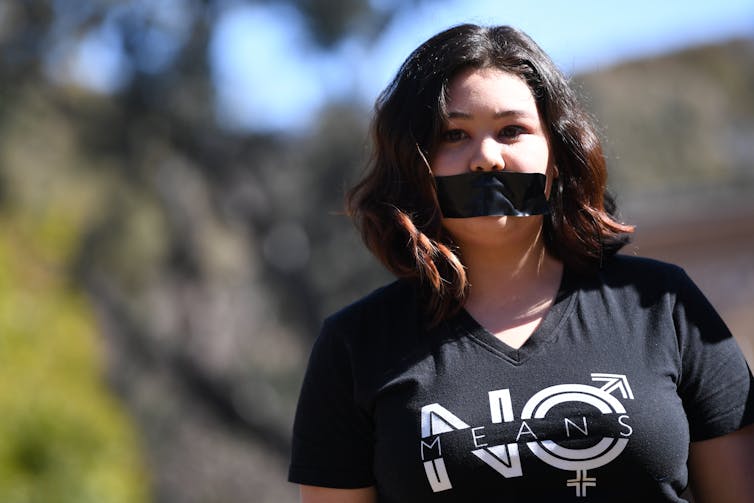 A student from ANU participates in a protest after the release of the AHRC survey in Canberra, August 2017.
Lukas Coch/AAP
A student from ANU participates in a protest after the release of the AHRC survey in Canberra, August 2017.
Lukas Coch/AAP
We don’t yet know whether the efforts and actions to improve university responses have helped to reduce rates of sexual assault and sexual harassment.
There have been a number of investigations and reports following the release of the AHRC findings. These reports suggest sexual violence continues to be rife in Australian universities. The AHRC survey will be repeated every three years and the next survey will provide insight into how things have changed.
But survey results must be interpreted cautiously. Some participants may not label their experiences as “sexual assault” or “sexual harassment”. Also, surveys conducted in English might not adequately capture the experiences of international students because of cultural and language barriers.
Under-reporting
The AHRC survey found sexual assault and sexual harassment were rarely reported to universities. The survey found 87% of students who were sexually assaulted, and 94% of those who were sexually harassed, didn’t make a formal report or complaint to their university.
Read more: Rape, sexual assault and sexual harassment: what’s the difference?
The study found domestic students were more likely than international students to report experiencing sexual assault and sexual harassment. But international students were almost two times less likely to seek support from someone in their faculty or school.
Overall, only 4% of students thought their university was doing enough to provide clear and accessible information on sexual assault procedures, policies and support services.
How far have universities come?
In February 2016, the Respect. Now. Always. campaign was introduced by Australia’s 39 universities. The campaign sought to raise awareness of sexual assault and sexual harassment, make support services for students more visible and accessible, obtain data to guide further improvement in university policy and practice, and help universities share best practice resources.
 The Universities Australia ten-point plan includes initiatives to bring awareness to sexual assault and harassment.
David Moir/AAP
The Universities Australia ten-point plan includes initiatives to bring awareness to sexual assault and harassment.
David Moir/AAP
As part of the campaign, Universities Australia also developed a ten-point action plan. This includes initiatives such as respectful relationships education and specialist training for university staff and counsellors.
In July 2018, Universities Australia introduced a set of non-binding guidelines for universities. These guidelines refer to recording data, timeframes for reporting, resolutions and criminal investigations – among other things.
The AHRC has conducted two audits of the actions taken by Australian universities in response to the Change the Course report. One in December 2017, and the other in August 2018. The audits are based on information submitted to the federal Sex Discrimination Commissioner, Kate Jenkins, by 39 vice chancellors about how their universities have responded to the nine recommendations of the AHRC report.
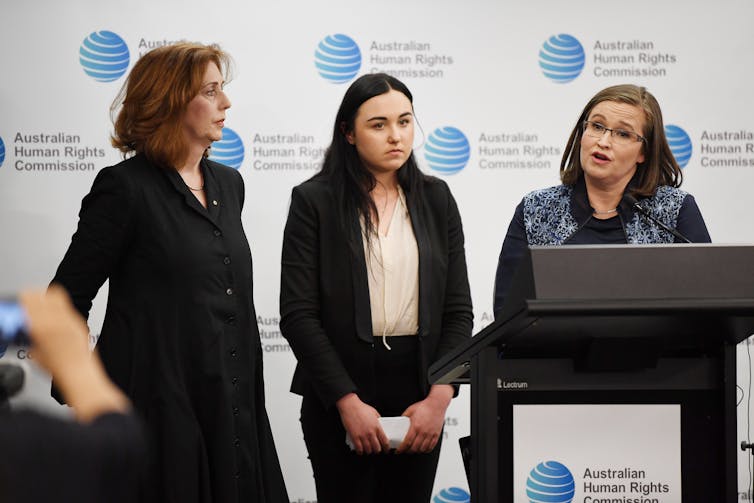 Kate Jenkins, the Sex Discrimination Commissioner, speaking after the release of the AHRC survey in 2017.
David Moir/AAP
Kate Jenkins, the Sex Discrimination Commissioner, speaking after the release of the AHRC survey in 2017.
David Moir/AAP
As of July 2018, the majority of universities have implemented the following measures, or are committed to doing so in the future:
- establish an advisory body or working group to develop an action plan
- implement training and education for students in relation to sexual assault, sexual harassment and respectful relationships
- take steps to increase the availability and visibility of support services
- implement a review of existing university policies and response pathways
- identify and train staff members and student representatives who are most likely to receive disclosures
- implement practices to ensure information about disclosures and reports is collected and stored confidentially
- express commitment to conduct the national survey on sexual assault and sexual harassment every three years.
The 2017 and 2018 audits also provide examples of the practical measures put in place by some universities. They include providing students with access to specialist sexual assault and trauma counsellors on campus, independent evaluations or audits, anonymous reporting tools and education and awareness campaigns.
Read more: University sexual assault policies are often 'inconsistent' and 'confusing'
Responses showcasing how individual universities have responded to each of the AHRC’s nine recommendations can be found on the AHRC website.
In January this year, the Tertiary Education Quality and Standards Agency (TEQSA) released their report to the federal minister of education on higher education provider responses to sexual assault and harassment. Overall, TEQSA found the majority of universities have done the following:
- accepted the Change the Course recommendations and are responding to the issue of sexual assault and sexual harassment
- established a sexual assault/sexual harassment taskforce
- implemented or strengthened a policy on sexual assault and sexual harassment
- conducted external or internal reviews of existing policies and response pathways
- offered online and face-to-face training for university staff and support services
- offered counselling services (some of whom collaborate with external rape/sexual assault support services)
- reported incident data internally.
Only some universities report their incident data publicly and/or have conducted reviews of their counselling services and student accommodation.
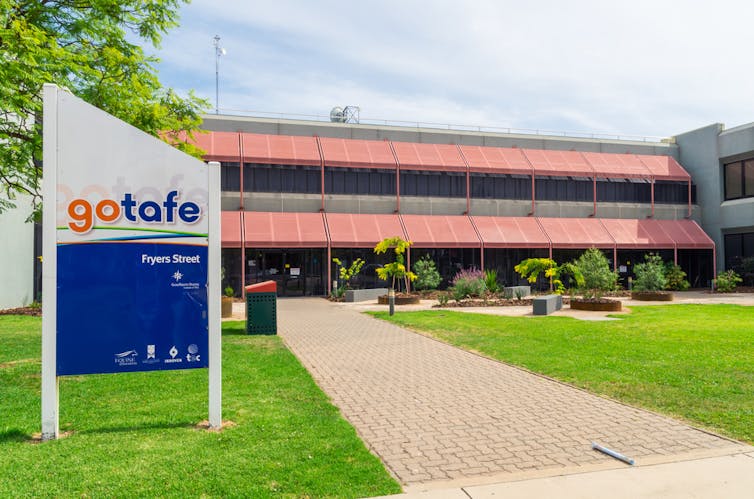 TAFEs have done less than universities to respond to sexual assault and harassment.
from www.shutterstock.com
TAFEs have done less than universities to respond to sexual assault and harassment.
from www.shutterstock.com
TEQSA also reported on the responses and actions of 126 independent and TAFE higher education providers. TESQA found independent and TAFE higher education providers have taken far less action. For instance, only 58% reported having a policy in relation to this issue. Only 13% had completed a review of sexual assault and harassment policy and practice.
Preventing sexual assault and harassment
This month, it was announced that Our Watch has partnered with universities and the Victorian government to develop a new evidence-informed respectful relationships education course. The online module will be trialled with students over the next 18 months.
Read more: Everyday rape: let's turn the spotlight on known perpetrators
The initiatives and actions taken to date by the majority of Australian universities are commendable. But so much more needs to be done within and beyond universities.
The biggest challenge we face in addressing sexual assault and harassment is much bigger than the university sector. It involves massive cultural change across our entire society. But Australian universities have the opportunity to show leadership on this issue. Let’s not waste that opportunity.
The National Sexual Assault, Family & Domestic Violence Counselling Line – 1800 RESPECT (1800 737 732) – is available 24 hours a day, seven days a week for any Australian who has experienced, or is at risk of, family and domestic violence and/or sexual assault.
Authors: Nicola Henry, Associate Professor & Vice-Chancellor's Principal Research Fellow, RMIT University


 Daily Bulletin


