Doctors request a urine test to help diagnose and treat a range of conditions including kidney disorders, liver problems, diabetes and infections. Testing urine is also used to screen people for illicit drug use and to test if a woman is pregnant.
Urine can be tested for particular proteins, sugars, hormones or other chemicals, certain bacteria and its acidity or alkalinity.
Doctors can also tell a lot from how your urine looks and smells. For example dark urine could be a sign of dehydration; a cloudy appearance may suggest infection; if the urine is a reddish colour there may be blood in it; and a sweet smelling urine can be a sign of diabetes.
Do I have an infection?
The most common reason for analysing urine is to identify a bacterial infection in your urinary tract, your body’s drainage system for removing urine. Urinary tract infections are particularly common in women, affecting almost 50% in their lifetime.
Urine tests not only tell you if there’s an infection, they can identify the offending organism. That helps the doctor know how best to treat the infection, including prescribing the right type of antibiotic (one that particular microorganism is sensitive to).
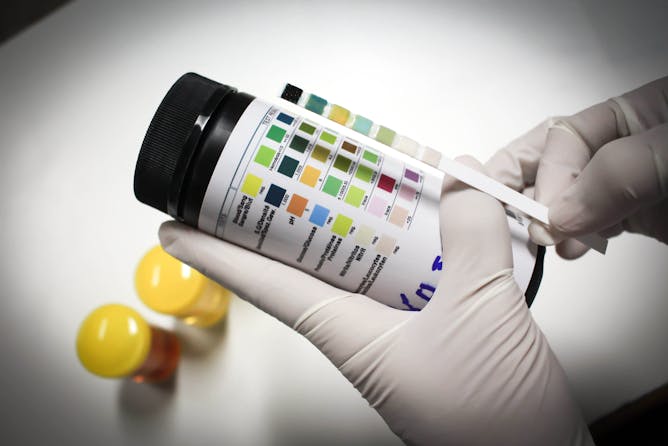
At the GP, the first test uses a dipstick or strip test (sometimes called a rapid urine test). This involves dipping a specially treated plastic or paper strip into a urine sample collected in a sterile plastic pot.
The doctor compares the colour of the test strip with a chart of standard colours. If the strip test detects (is positive for) white blood cells (leucocytes), blood and/or chemicals called nitrites, infection is likely.
 Your GP usually performs a quick dipstick test, where the colour of the test paper changes according to what the urine contains. from shutterstock.com
Then, the doctor sends off a sample of the urine to the laboratory for further testing. There, a laboratory technician can view it under a microscope to look for bacteria and cells. If the white cell count is above a baseline level, or if organisms are identified (and the patient has symptoms), an infection is very likely.
Further testing in the laboratory involves culturing the bacteria from the urine (by growing it in a special medium) and testing different antibiotics on it to see which one is most effective.
How your urine sample is handled in hospital may be different. Larger hospitals have a laboratory on site and patients will usually wait in the emergency department for the results of the laboratory microscopic evaluation. Doctors then start treatment with this extra information.
Patients sent home from the emergency department will still need to visit their GP for the final laboratory results, such as the antibiotic sensitivities. If you are admitted to hospital, treatment will start and may be modified once these results are known.
Sterile samples are vital
For any of these tests to be valid, the urine sample needs to be sterile (without contamination). To obtain a sterile sample in hospital, that might involve inserting a catheter (a tube that collects urine from the bladder) or a needle into the bladder (suprapubic aspiration).
But the most common method is by asking for a mid-stream urine sample (also known as clean-catch urine sample). This is when you urinate the first part of the urine stream into the toilet, collect the middle part of the stream in a sterile container, then empty the rest of the bladder into the toilet.
The idea is that the first discarded urine flushes out any bacteria or skin cells from the penis or vagina leaving the mid-stream sample as a truly representative sample to test.
Instructions are often vague
But many patients will recall being asked to provide a urine sample without adequate explanation of how to do it. They are simply handed a sample container and given directions to the toilet.
Without instruction patients may not know how to prepare their external genitalia. For women this involves parting the labia or lips of the vagina, while for men, this involves retracting the foreskin.
Nor are patients clearly advised how to provide the sample. As a result, they can contaminate the container and its lid by not washing their hands, and their sample often contains the first rather than mid-stream urine.
In these cases, what actually gets into the sample are contaminants; cells and bacteria from hands; or cells and bacteria from the lower part of the urinary tract and genitalia.
Unfortunately for women, their anatomy is more likely to result in more of this latter contamination as they have to void through the vagina into the container, while men void directly into the container.
Why is a contaminant-free sample important?
If the sample is contaminated there are various consequences. The laboratory will report contamination and advise the doctor to take care in interpreting results. However, a contaminated sample can result in incorrect diagnosis and incorrect or unnecessary treatment.
A new sample will probably be needed. This causes delays in diagnosis and treatment, potential anxiety to the patient and additional costs.
In our hospital, where the emergency department collects more than 1,000 mid-stream samples each month, women’s samples are contaminated over 40% of the time. In a recent trial visual instructions in the form of cartoons were provided on how to collect the samples.
We paid particular attention to hand washing and collection technique. The number of contaminated samples was reduced by 15%. This potentially could save upwards of 150 repeat tests a month and those instructions are now provided to all patients in the emergency department.
If you are unsure how to take a sterile sample, ask your doctor or nurse for more information. It can save you the time, inconvenience and worry of coming back for another sample.
Authors: Rob Eley, Academic Research Manager, Princess Alexandra Hospital Southside Clinical Unit, The University of Queensland


 We need to find new ways to deal with the complexity of modern cities and make them better.from www.shutterstock.com


 Daily Bulletin


