

How tracking people moving together through time creates powerful data
- Written by: Tiffany Gill, Senior Research Fellow, University of Adelaide
This article is part of the series This is research, where we ask academics to share and discuss open access articles that reveal important aspects of science. Today’s piece looks at a vital concept in medical studies: the cohort.
Are you in a cohort? Perhaps a posse of friends, a sporting team, the “class of 1989” Facebook group from your former school?
“Cohort” is collective term used to refer to people with something in common – historically it described a group of soldiers, but now is most often used in research contexts.
Cohort studies typically involve recruiting a group of people to look at causes of disease. Cohorts are followed over time, in longitudinal studies – imagine the people marching forward together through the years, like a group of soldiers.
One of the most well-known cohort studies – the Framingham Heart Study – first clearly identified something that most of us now take for granted: heart attacks and other forms of heart disease run in families.
Read more: Heart attacks more frequent in colder weather
The causes of heart disease
The Framingham Heart Study commenced in 1948, and was designed to understand why increasing numbers of people in the United States had heart disease. It was so named because the town of Framingham, Massachusetts, was chosen as the study site.
The main aim of the study was to determine risk factors for heart disease, and then use these to create public health programs.
To date, the study has been vital in identifying important risk factors in heart disease development, such as:
- high blood pressure, weight gain and high cholesterol
- male sex and increasing age
- diabetes
- smoking.
Initially, 5209 men and women took part in the study. But since then, researchers have recruited children of the original cohort, and a third generation cohort of grandchildren. The original recruits have now been examined over 30 times.
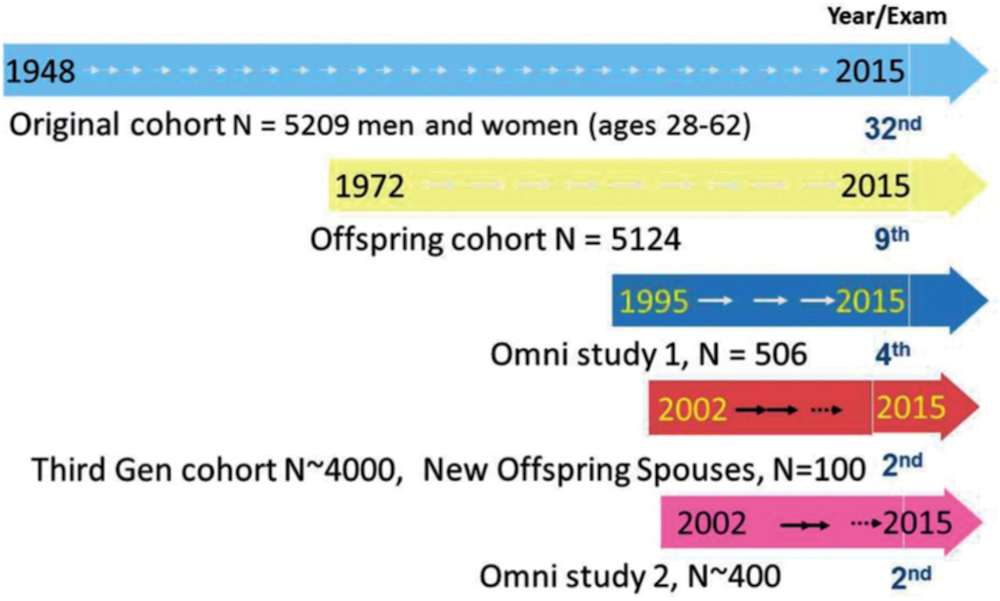 A 2015 snapshot of the time course of enrolment of the original and subsequent cohorts within the Framingham Heart Study. N refers to the number of people in each cohort.
Reproduced from Benjamin I et al. Circulation 2015; 131: 100–12
A 2015 snapshot of the time course of enrolment of the original and subsequent cohorts within the Framingham Heart Study. N refers to the number of people in each cohort.
Reproduced from Benjamin I et al. Circulation 2015; 131: 100–12
The population of Framingham has also changed over the years, from predominantly white to a more diverse population – people of African American, Hispanic, Asian and Native American descent have been recruited.
Read more: Research Check: will a coffee a day really keep heart attacks at bay?
High quality data
Framingham is known for a very high rate of keeping people involved in the study. This is due to the constant follow up by the staff.
There are examination visits every two to six years, with staff members travelling to participants if they are unable to come to the measurement centres. There are follow up questionnaires and telephone calls between examinations, not only for local residents but also for participants who live in other parts of the United States or the world. Keeping participants in the study ensures that the quality of the data and research outcomes are maintained at a high level.
While Framingham originally focused on cardiovascular disease, it has now also examined diabetes, stroke, dementia, cancer, osteoporosis and osteoarthritis.
 The Framingham Study involves regular follow up to take health measurements such as blood pressure.
rawpixel/Unsplash, CC BY
The Framingham Study involves regular follow up to take health measurements such as blood pressure.
rawpixel/Unsplash, CC BY
A cohort study like Framingham follows individuals over time to investigate the causes of disease, record disease outcomes (such as illness and death) and establish links with disease risk factors. But such a study is also analytical: comparisons can be made between the general population and the cohort.
Cohort studies provide high quality evidence on the risk factors and causes of disease. Cohort studies can also describe the incidence of diseases – the number of new cases of a disease that occur in a specific timeframe.
However, these types of studies are observational: that is, they do not include a specific intervention or treatment to address a particular disease.
Read more: The curious case of the missing workplace teaspoons
Forward and back
The Framingham study design is “prospective” – it was planned in advance and the studies carried out moving forwards over a period of time. Other cohort studies are “retrospective” – looking at data that already exists.
In addition to Framingham, other cohort studies have provided a significant amount of information about:
Read more: Research Check: can you cut your cancer risk by eating organic?
Cohort studies are particularly important for examining diseases that take a long time to develop, and for exploring the effect of social and environmental factors on health. They are not useful for looking at rare, or sudden disease outbreaks. They are expensive and can take a long time to produce results.
But they have provided some of the most significant information on some of today’s biggest health problems.
The open access research paper for this analysis is Cohort Profile: The Framingham Heart Study (FHS): overview of milestones in cardiovascular epidemiology.
Authors: Tiffany Gill, Senior Research Fellow, University of Adelaide


 Daily Bulletin


