Daily Bulletin

Men's Weekly

.

How do solar panels work?

  • Written by Andrew Blakers, Professor of Engineering, Australian National University
how do solar panels work?

How do solar panels work? – Nathan, age 5, Melbourne, Australia.

The Sun produces a lot of energy called solar energy. Australia gets 20,000 times more energy from the Sun each day than we do from oil, gas and coal. This solar energy will continue for as long as the Sun lives, which is another 5 billion years.

Solar panels are made of solar cells, which is the part that turns the solar energy in sunlight into electricity.

Solar cells make electricity directly from sunlight. It is the most trusted energy technology ever made, which is why it is used on satellites in space and in remote places on Earth where it is hard to fix problems.

Read more: Curious Kids: how does electricity work?

How do solar cells work?

Solar cells are made using silicon atoms. An atom is basically a building block – just like a Lego brick but so tiny you’d need a special machine to see them.

Because the silicon atoms are so small you need trillions and trillions of them for a solar cell.

To make the solar cell you need a wafer layer of silicon, about the same size as a dinner plate but much much thinner – only about three times the thickness of a strand of your hair.

This silicon layer is changed in a special way using hot temperatures of up to 1,000℃. Then, a sheet of metal is put onto the back of the layer and a metal mesh with holes in it, like a net, is put on the front. It is this mesh side of the layer that will face the Sun.

When 60 solar cells are made they are fixed together behind a layer of glass to make a solar panel.
how do solar panels work?

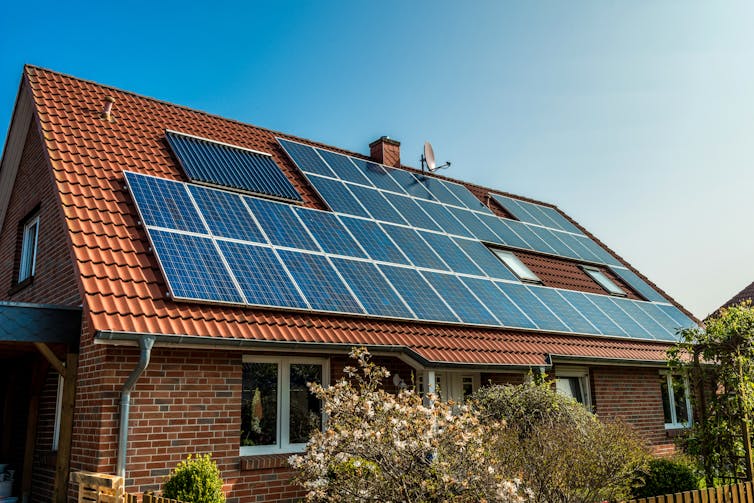
On this roof you can see one solar hot water collector (top left) and 42 solar electricity panels, each of which is made of 60 solar cells combined behind a protective glass.

If your house has a solar power system, it will probably have 10 to 50 solar panels attached to your roof. Millions of solar panels are used to make a large solar farm out in the countryside.

Each silicon atom contains extremely tiny and lightweight things called electrons. These electrons each carry a small electric charge.
how do solar panels work?

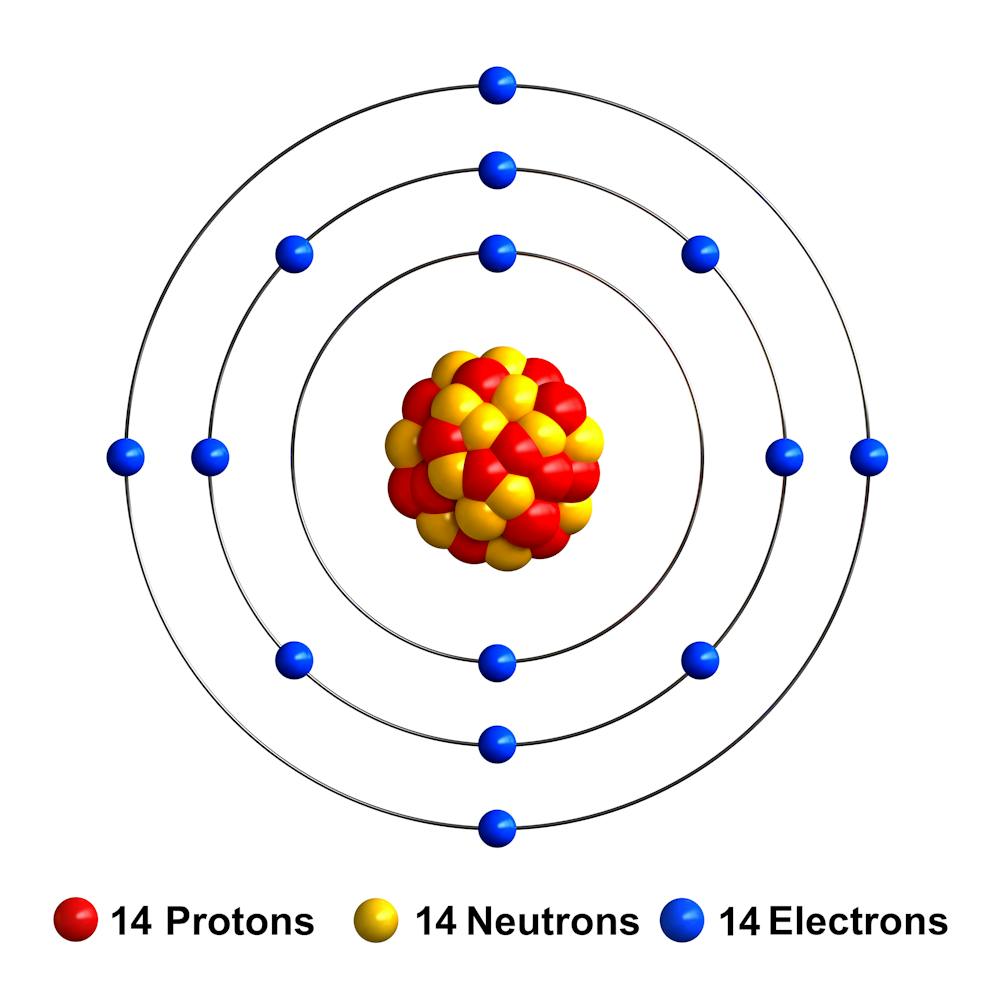
Each tiny silicon atom has a nucleus at the centre made up of 14 teeny-tiny protons and 14 teeny-tiny neutrons. And 14 teeny-tiny electrons go around the nucleus. It doesn’t really look exactly like this diagram but you get the idea.

When sunlight falls on a solar panel it can hit one of the electrons in a silicon atom and knock it free.

These electrons can move around but because of the special way the cell is made they can only go one way, up towards the side that faces the Sun. They can’t go the other way.

So whenever the Sun is shining on the solar cell it causes many electrons to flow upwards but not downwards, and this creates the electric current needed to power things in our homes such as lights, the television and other electrical items.

If the sunlight is bright, then lots of electrons get hit and so lots of electric current can flow. If it is cloudy, then fewer electrons get hit and the current will be cut by three quarters or more.

At night, the solar panel produces no electric power and we need to rely on batteries or other sources of electricity to keep the lights on.

How are solar cells being used?

Solar cells are the cheapest way to make electricity – cheaper than new coal or nuclear power stations. This is why solar cells are being installed around the world about five times faster than coal power stations and 20 times faster than nuclear power stations. In sunny places like San Diego, solar costs are easily paid for by the amount of power they produce.

In Australia, nearly all new power stations are either solar power stations or wind farms. Solar and wind electricity can be used to run electric cars in place of polluting petrol cars. Solar and wind electricity can also heat and cool your house and can be used in industry in place of coal and natural gas.
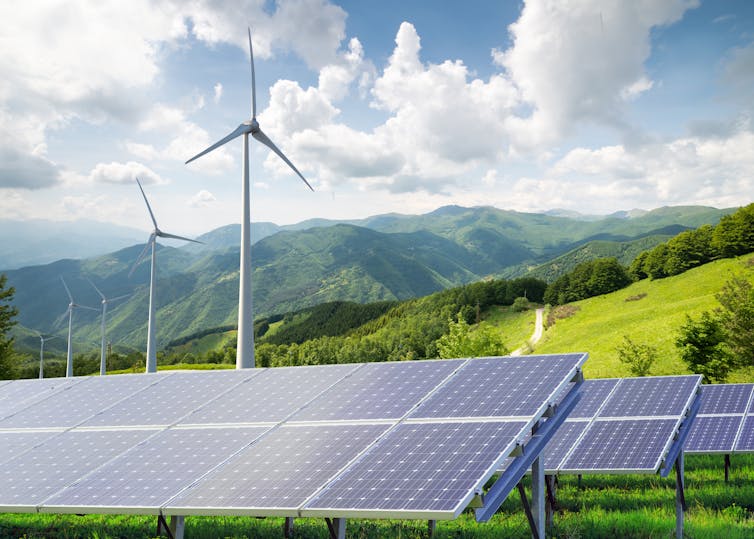
how do solar panels work?
Windmills and solar panels can produce electricity. 

Solar and wind are helping lessen the amount of greenhouse gases which damage our Earth. They are cheap, and they continue to get even cheaper and the more we use it, the quicker we can stop using energy that can hurt the Earth (like coal, oil and gas). Solar panels are actually at the stage where they are financially beneficial for households, meaning the energy savings are greater than the expenses of installing them. If you’re looking for solar panels in Sydney, you only need to look up at roofs of a few neighbours, and you’ll notice how common they are, as more and more people realise their benefits.

What’s more, silicon is the second most common atom in the world (after oxygen). In fact, sand and rocks are made of mostly silicon and oxygen. So, we could never run out of silicon to make more solar cells.

Read more: Curious Kids: why do we not use the magnetic energy the Earth provides to create electricity?

Hello, curious kids! Have you got a question you’d like an expert to answer? Ask an adult to send your question to curiouskids@theconversation.edu.au

Authors: Andrew Blakers, Professor of Engineering, Australian National University

Read more http://theconversation.com/curious-kids-how-do-solar-panels-work-123515

Australia wants to host the 2023 FIFA Women's World Cup. Equal pay for the Matildas will help our chances

  • Written by Lee McGowan, Senior Lecturer, Queensland University of Technology

Women’s football has never looked better.

1.85 million Australians play football, including over 400,000 women and girls. Over 1 billion people watched the 2019 FIFA Women’s World Cup in France. Club level matches in England, Spain and Italy draw crowds of over 30,000 people. This coming weekend, England will play to a sold-out Wembly...

Read more

Should you worry about Boeing 737s? Only if you run an airline

  • Written by John Page, Senior Lecturer with the School of Mechanical and Manufacturing Engineering, UNSW

The cracks found in three Qantas-owned Boeing 737s last week led to calls that it should ground its 33 aircraft with a similar service record.

Although the three planes have been grounded and will require complex repairs, the cracks – in a component called the pickle fork, which helps strengthen the join between the aircraft’s body and...

Read more

More Articles ...

  1. India's not joining the latest free-trade deal which limits Australia's market access
  2. just 15 years' worth of emissions will raise sea level in 2300
  3. Dogs really can chase away loneliness
  4. Running may help you live longer but more isn't necessarily better
  5. Recycling plastic bottles is good, but reusing them is better
  6. Olivia Colman shines as an older, frumpier Elizabeth
  7. Scott Morrison wants to outlaw boycott campaigns. But the mining industry doesn't need protection
  8. What is ‘ecological economics’ and why do we need to talk about it?
  9. No Australian city has a long-term vision for living sustainably. We can't go on like this
  10. Asylum seekers left 'desperate' and 'helpless' when they try to find work in Australia
  11. India’s social media content removal order is a nail in the coffin of the internet as we know it
  12. how to teach science and maths so students actually care
  13. Why is Japan's Olympic marathon shifting cities to avoid the heat? A sports physiologist explains
  14. Attorney-General Christian Porter targets Market Forces in push against environment groups
  15. a small, gentle, important film that reveals the vulnerability of men
  16. Curious Kids: how do fish sleep?
  17. A new bill keeping 10 year olds out of jail is a good start, but it needs to go further
  18. Is the Morrison government 'authoritarian populist' with a punitive bent?
  19. We asked 13 economists how to fix things. All back the RBA governor over the treasurer
  20. automatic cameras will spot mobile-using motorists, but at what cost?
  21. Strippers on film: battlers, showgirls and hustlers
  22. Opioid dependence treatment saves lives. So why don't more people use it?
  23. the secrets of the Kerguelen Plateau
  24. 'I cheated on a school exam and I feel terrible. How can I get past this?'
  25. How we feel about our cars means the road to a driverless future may not be smooth
  26. Twitter is banning political ads – but the real battle for democracy is with Facebook and Google
  27. Nearly all your devices run on lithium batteries. Here's a Nobel Prizewinner on his part in their invention – and their future
  28. Government to announce more home care packages for aged before Christmas
  29. Involving kids in making schools sustainable spreads the message beyond the classroom
  30. The aged care royal commission's 3 areas of immediate action are worthy, but won't fix a broken system
  31. Australia's hidden opportunity to cut carbon emissions, and make money in the process
  32. Michelle Grattan on the aged care royal commission report
  33. Are the Wallabies' struggles a sign of rugby union's decline in Australia?
  34. There's mounting evidence against cashless debit cards, but the government is ploughing on regardless
  35. Friday essay: thinking like a planet
  36. What time of day should I take my medicine?
  37. As the prime minister heads to ASEAN, trade, Vietnam and China will be high on the agenda
  38. Mosque clean-up shows Hong Kong is a city that stands up for everyone's rights
  39. Dingoes found in New South Wales, but we're killing them as 'wild dogs'
  40. Would you notice if your calculator was lying to you? The research says probably not
  41. Ken Wyatt juggles identity and politics
  42. Boris Johnson sends UK voters to the polls, hoping for the 'right' kind of Brexit. But it just might backfire
  43. 3 in 4 people with a mental illness develop symptoms before age 25. We need a stronger focus on prevention
  44. Robots can outwit us on the virtual battlefield, so let's not put them in charge of the real thing
  45. The science of drought is complex but the message on climate change is clear
  46. In Japan, supernatural beliefs connect the spiritual realm with the earthly objects around us
  47. are military dogs war heroes or just tools? It's time the law protected our furry troops
  48. how new tourism opportunities can empower the traditional owners of Uluru
  49. Don't just blame YouTube’s algorithms for ‘radicalisation’. Humans also play a part
  50. how the ghosts we believe in reflect our changing fears

Business News

Tips for Avoiding Probate Delays

Probate can be a lengthy process at the best of times, and delays often compound the stress that comes with managing a loved one's estate. Many of those delays are avoidable with the right preparati...

Daily Bulletin - avatar Daily Bulletin

Integrating Marketing Automation Workflows with Headless CMS: Creating a Unified Engine for Scalable Growth

Marketing automation is a necessary component of modern engagement with customers. Automated emails, triggered campaigns, lead nurturing and lifecycle messaging enable brands to scale their messagin...

Daily Bulletin - avatar Daily Bulletin

Why Split Corrugated Conduits Are Essential For Protecting Electrical And Solar Installations

Modern electrical systems require reliable protection for wiring and cables to ensure safety, durability, and long-term performance. In residential, commercial, and industrial environments, conduits a...

Daily Bulletin - avatar Daily Bulletin

Speed Dating For Business